

Advanced Peptides UK supplies research materials only. 18+ Products not for human consumption.
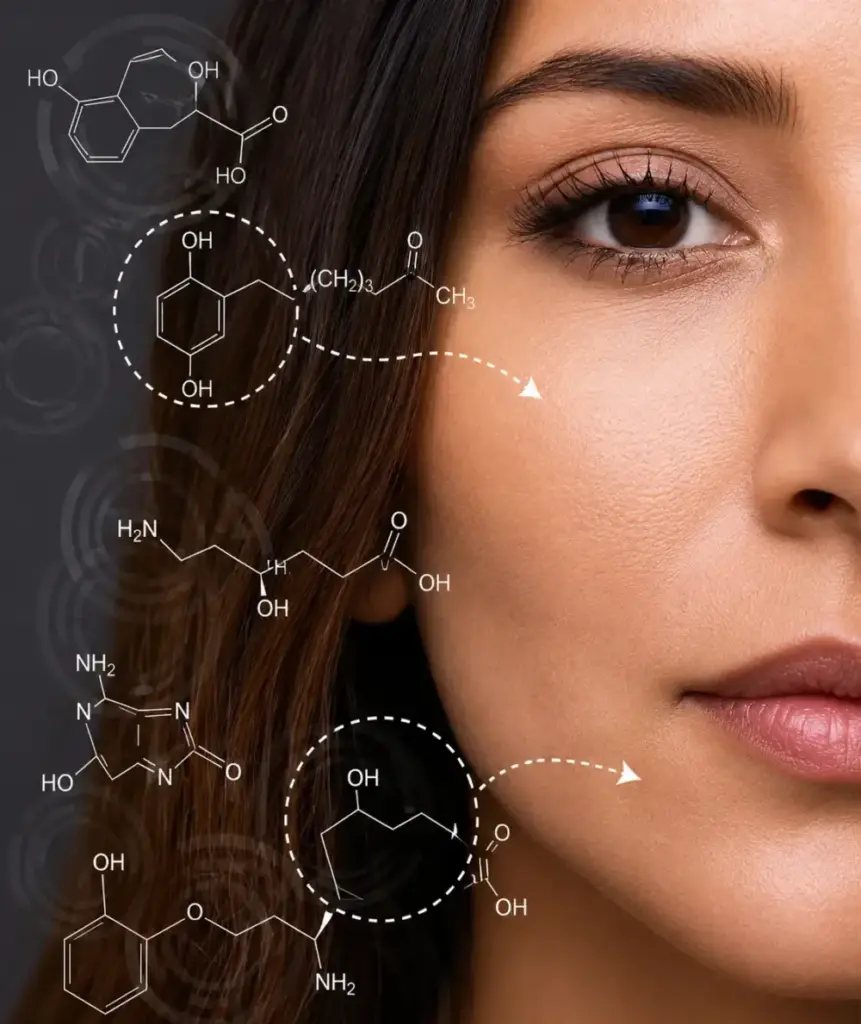
Understanding Peptides in Skin Health & Follicular Biology
Peptides are short chains of amino acids that can act as biological signalling molecules. Research is investigating how specific peptides interact with pathways involved in collagen synthesis, extracellular-matrix remodelling, inflammation, tissue repair and hair-follicle activity.
Research explores pathways relevant to:
GHK-Cu (glycyl-L-histidyl-L-lysine–copper) is one of the more extensively studied peptides in skin biology. Research has investigated its interaction with dermal fibroblasts, collagen synthesis and extracellular-matrix remodelling. Recent research using human dermal fibroblasts and ex-vivo human skin has examined GHK-Cu in relation to collagen I, IV and VII expression, providing further evidence for its relevance to skin-matrix biology [1]. The main areas of research can therefore be summarised as fibroblast activity → collagen synthesis → extracellular-matrix regulation → tissue remodelling.
KPV is a tripeptide derived from α-melanocyte-stimulating hormone (α-MSH). Melanocortin-derived peptides have been investigated for their interactions with melanocortin receptors and their potential influence on inflammatory and immune signalling. Research has explored melanocortin pathways in relation to inflammatory regulation, immune-cell activity and epithelial protection, with KPV representing one of the smaller peptide sequences studied within this pathway [2]. The primary research areas can be described as melanocortin signalling → inflammatory regulation → immune activity → epithelial defence.
Thymosin β4 (Tβ4) is a naturally occurring peptide involved in several cellular processes, including actin regulation and cell migration. Research has investigated Tβ4 in relation to cell migration, angiogenesis, wound closure and tissue remodelling. These mechanisms have made thymosin β4 an area of interest within regenerative and wound-healing research [3]. Its research pathway can broadly be summarised as cell migration → angiogenesis → wound closure → tissue remodelling.
Hair follicles are highly dynamic structures regulated by interactions between dermal papilla cells, keratinocytes, stem-cell populations and the surrounding tissue environment. Research into peptide signalling is investigating whether specific molecules can influence pathways involved in follicular activity, hair-shaft production and regulation of the hair-growth cycle. This represents an emerging area of peptide research, with different molecules being investigated for their potential effects on cellular signalling within the follicle.
The pentapeptide Gly-Pro-Ile-Gly-Ser (GPIGS) has been investigated in human hair-follicle models as well as in a randomised clinical study involving men with androgenetic alopecia. Research has linked GPIGS with hair-bulb keratinocyte activity, while clinical research reported an increase in the proportion of thicker hairs following topical application [4]. More broadly, recent research reviews have identified a range of experimental short peptides being investigated in relation to pathways including PI3K/Akt, GSK-3β/β-catenin, AMPK, mTORC1, autophagy and inflammatory signalling, all of which have potential relevance to hair biology [5]. The broader research pathway can be summarised as follicular signalling → keratinocyte/dermal-papilla activity → hair-cycle regulation → hair-shaft production.
Research at a glance
| Peptide | Biological pathway investigated | Research area |
| GHK-Cu | Collagen & extracellular matrix | Skin |
| KPV | Melanocortin & inflammatory signalling | Skin |
| Thymosin β4 | Cell migration & angiogenesis | Tissue repair |
| GPIGS | Follicular / PI3K-Akt signalling | Hair |
| Emerging short peptides | Multiple follicular signalling pathways | Hair research |
Interpreting the research
Peptide research covers a wide range of biological mechanisms, and the strength of evidence varies between individual compounds.
Laboratory, ex-vivo and preclinical studies can help identify biological pathways and mechanisms. Controlled human clinical studies are required to establish whether a particular peptide is safe and effective in people.
The mechanisms described above therefore represent areas of scientific investigation rather than established clinical effects.
References
1. Jiang, F., Wu, Y., Liu, Z., Hong, M. and Huang, Y. (2023) ‘Synergy of GHK-Cu and hyaluronic acid on collagen IV upregulation via fibroblast and ex-vivo skin tests’, Journal of Cosmetic Dermatology, 22(9), pp. 2598–2604. doi:10.1111/jocd.15763.
2. Brzoska, T., Luger, T.A., Maaser, C., Abels, C. and Böhm, M. (2008) ‘Alpha-melanocyte-stimulating hormone and related tripeptides: biochemistry, anti-inflammatory and protective effects in vitro and in vivo, and future perspectives for the treatment of immune-mediated inflammatory diseases’, Endocrine Reviews, 29(5), pp. 581–602.
3. Kleinman, H.K. and Sosne, G. (2016) ‘Thymosin β4 promotes dermal healing’, Vitamins and Hormones, 102, pp. 251–275. doi:10.1016/bs.vh.2016.04.005.
4. Iwabuchi, T. et al. (2016) ‘The topical penta-peptide Gly-Pro-Ile-Gly-Ser increases the proportion of thick hair in Japanese men with androgenetic alopecia’, Journal of Cosmetic Dermatology, 15(2), pp. 176–184. doi:10.1111/jocd.12216.
5. Fan, C., Chen, Y., Huang, Q. et al. (2026) ‘Overview of Short Peptides for Hair Loss’, Biomedicines, 14(4), 864. doi:10.3390/biomedicines14040864.
Research disclaimer
The information presented on this page summarises published scientific research and is provided for educational purposes. Findings from laboratory, ex-vivo or preclinical research do not establish a clinical benefit in humans. Experimental peptides should not be assumed to be safe or effective for personal use.


Order with confidence from a UK-based supplier focused on clear specifications, secure checkout and research-use compliance.
Products are supplied for laboratory research use only. Not for human consumption.